MARTA Bus: Routes, Schedules, Tracker & 2026 Changes
MARTA operates Atlanta’s public bus network across Fulton and DeKalb counties, with standard fares at $2.50 per trip. On April 18, 2026, MARTA launches its NextGen Bus Network, replacing 113 routes with 81 more frequent fixed routes plus 12 new MARTA Reach on-demand zones, tripling high-frequency corridors across the system.
What Is MARTA Bus and Where Does It Operate?
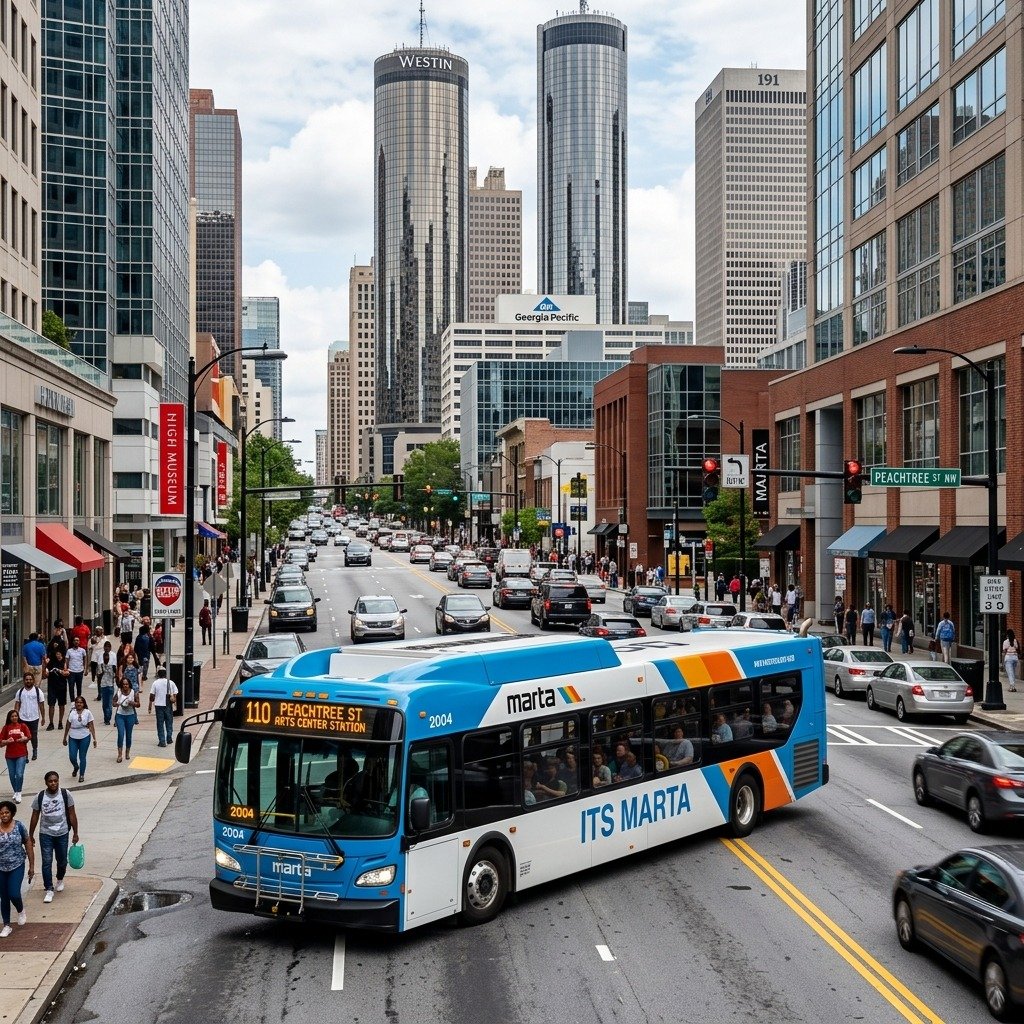
MARTA (Metropolitan Atlanta Rapid Transit Authority) bus service is the largest component of Atlanta’s public transit system, connecting neighborhoods across the city with rail stations, employment centers, and daily destinations. MARTA’s combined bus, rail, and paratransit network handles more than 500,000 passenger trips every weekday within Atlanta, Fulton County, and DeKalb County.
MARTA buses work alongside three other MARTA services:
- Rail: Four color-coded lines (Red, Gold, Blue, Green) connecting 38 stations
- Rapid A-Line: A bus rapid transit (BRT) route functioning like a hybrid between bus and rail
- Atlanta Streetcar: A separate downtown loop with its own $1.00 fare
Buses typically serve as the “last mile” connector, getting riders from a rail station to their final destination, though many routes also operate independently across the metro area.
What Are the Current MARTA Bus Routes?
MARTA currently operates over 100 numbered bus routes plus the Rapid A-Line, covering corridors throughout Atlanta, Fulton County, and DeKalb County. Routes are organized by corridor name and number, such as Route 4 (Moreland Avenue) or Route 23 (Peachtree Road/Buckhead), and most connect directly to at least one rail station.
Some of the most heavily traveled corridors include:
| Route | Corridor | Area Served |
| A | Rapid A-Line | Bus Rapid Transit corridor |
| 1 | Joseph E. Lowery Blvd / 17th St | Downtown/Midtown |
| 3 | Martin Luther King Jr. Drive | West Atlanta |
| 4 | Moreland Avenue | East Atlanta |
| 15 | Clifton Road / Candler Road | DeKalb County |
| 23 | Peachtree Road / Buckhead | North Atlanta |
| 39 | Buford Highway | Northeast Atlanta/DeKalb |
| 85 | Roswell | North Fulton |
Important note: This entire route structure is changing on April 18, 2026. The NextGen Bus Network will reduce the total number of fixed routes to 81, while adding 12 new on-demand Reach zones. If you’re memorizing a route number today, confirm it’s still valid after mid-April 2026 using MARTA’s Route Crosswalk tool, which maps every old route to its NextGen replacement.
How Do I Find MARTA Bus Routes Near Me?
To find MARTA bus routes near a specific address, use the MARTA Trip Planner at tracker.itsmarta.com/plan, which shows nearby stops, active routes, and walking directions based on your location. The MARTA app offers the same functionality on mobile, including a “My Location” feature that centers the map on where you’re standing.
A few practical tips for locating your nearest route:
- Use the interactive route map on itsmarta.com to browse routes by geographic area rather than route number.
- Check for temporary signage at your stop starting December 2025, MARTA began installing temporary bus stop signs at locations affected by the NextGen changes, so a sign at your usual stop may indicate a new route number or a discontinued stop.
- Look up your address on the Reach Zone map if you live in a lower-density area. Some stops served today may transition to MARTA Reach’s on-demand curb-to-curb service instead of a fixed route after April 18, 2026.
- Call customer service at 404-848-5000 if the online tools don’t clarify your specific stop.
What Is the MARTA Bus Schedule?
MARTA buses generally operate from 5 a.m. to 1 a.m. on weekdays and 5 a.m. to 12:30 a.m. on weekends, though exact frequency and hours vary by individual route. Each route has its own timetable, and riders should check the specific schedule for their route rather than assuming uniform service across the system.
Frequency depends heavily on which route you’re riding and time of day. Currently, only a handful of corridors offer service every 15 minutes or better throughout the day. That’s set to change significantly with NextGen:
| Network | High-frequency corridors (15 min or better, all day) | Total routes/services |
| Current network | 5 corridors | 113 routes |
| NextGen (April 18, 2026) | 17 corridors | 81 routes + 12 Reach zones (93 total) |
Beyond the frequency boost, NextGen also introduces something Atlanta bus riders haven’t had before: consistent service levels seven days a week. Under the new network, most of the 81 fixed routes will run at similar frequency whether it’s a Monday commute or a Sunday afternoon, a shift from the current system’s weekday-heavy scheduling.
To find your specific route’s timetable, both current and NextGen schedules are posted on MARTA’s Find Your Bus Route page, searchable by route number.
How Does the MARTA Bus Tracker Work?
The MARTA Bus Tracker provides real-time arrival predictions for any stop, accessible through the MARTA Trip Planner at tracker.itsmarta.com or the official MARTA app. Riders enter a stop, station, or address to see live arrival times rather than relying solely on printed schedules.
MARTA’s rider tools recently got an overhaul, described by the agency as “new Rider Tools” for both web and mobile, with improved trip planning, accessibility features, and language support. Here’s how to use it:
- Visit itsmarta.com/ride/arrivals or open the MARTA app.
- Enter your stop, station, or current location.
- View real-time bus and rail arrival predictions.
- Set up the trip planner to compare route options, including transfers.
One practical scenario worth planning for: if you’re standing at a stop and the tracker shows your bus is delayed, check whether an alternate route or a walk to a nearby rail station gets you there faster. This is especially useful during the NextGen transition, when adjusted running times may cause temporary irregularities as operators adjust to new routing.
How Much Does a MARTA Bus Ride Cost?
A standard one-way MARTA bus ride costs $2.50 and includes up to four free transfers to other buses or trains within three hours. Reduced fares of $1.00 are available for seniors 65 and older, Medicare cardholders, and people with disabilities, while children 46 inches and under ride free (limited to two children per paying adult).
| Fare type | Price | Who qualifies |
| Standard one-way | $2.50 | All riders |
| Reduced fare | $1.00 | Seniors 65+, Medicare cardholders, people with disabilities |
| MARTA Mobility | Free (with photo ID card) | ADA paratransit-qualified riders |
| Children | Free | 46 inches and under, 2 per paying adult |
| 1-Day Pass | $9.00 | Unlimited rides, 24 hours |
| 7-Day Pass | $23.75 | Unlimited rides, 7 days |
| 30-Day Pass | $95.00 | Unlimited rides, 30 days |
According to MARTA, the bus fare itself is not changing as part of the NextGen redesign it remains $2.50 regardless of which route structure is in place. If you’re a frequent rider, comparing the cost of individual trips against a weekly or monthly pass is worth doing: a 7-Day Pass pays for itself after about 10 one-way trips.
One important transfer rule to know: when transferring between bus and rail, you must tap the exact same payment method both times. Tapping a debit card on the bus, then a different card (or even a mobile wallet linked to the same bank account) at the rail faregate, will trigger an extra charge instead of registering as a free transfer.
What Is the NextGen Bus Network, and When Does It Launch?
The NextGen Bus Network is MARTA’s complete redesign of its bus system, launching April 18, 2026, marking the first time since MARTA began bus operations in the early 1970s that the entire network has been redrawn from scratch. It reduces the number of fixed routes from 113 to 81 while adding 12 new on-demand MARTA Reach zones, prioritizing frequency and directness over route coverage alone.
According to MARTA, the redesign is projected to give the average rider access to 31% more hospitals, 27% more grocery stores, 22% more jobs, and 21% more colleges and universities within a 60-minute travel window, compared to the current network. MARTA also states that 6% more people in the region will live within a quarter mile of MARTA service under the new system, and that 38,500 more people gain access to service overall.
Is MARTA cutting service? According to MARTA’s own FAQ, no despite fewer total routes, the agency states that many NextGen routes are more direct, arrive more frequently, and reach more destinations, with the 12 new Reach zones covering areas that previously had infrequent fixed-route service.
A related but separate service, MARTA Reach, actually launches earlier, on March 7, 2026, ahead of the full NextGen rollout. It’s worth checking both dates so you’re not caught off guard by a route or on-demand zone change before the main launch date.
What Is MARTA Reach, and How Do You Book It?
MARTA Reach is a new on-demand, curb-to-curb transit service operating in 12 zones across MARTA’s service area, using small ADA-accessible vans instead of fixed bus routes. It runs daily from 6 a.m. to midnight, and riders book trips through the MARTA Reach app, the online booking portal, or by calling the reservations line directly.
This matters for riders in lower-density areas where a traditional fixed bus route wasn’t practical to run frequently. Instead of waiting on a schedule, you request a ride within your zone and get picked up curbside.
To book MARTA Reach:
- Download the MARTA Reach On-Demand Transit App (available for Android and iOS).
- Alternatively, book online at book.martareach.rideco.com.
- Or call the Reservations line at 404-848-6622.
Regarding cost: MARTA Reach fare is free until Better Breeze equipment is fully installed, after which it will match the standard $2.50 fare. Confirm current pricing directly with MARTA before you ride, since the transition timeline for fare equipment varies by location.
Several Reach zones also connect to specific out-of-zone points, letting riders reach a nearby rail station or bus route outside their zone boundary. For example, Zone 304 (Lakewood) connects to the Lakewood/Ft. McPherson Rail Station, while Zone 309 (Candler-McAfee/Belvedere Park) connects to the South DeKalb Transfer Point.
How Do You Pay for a MARTA Bus? (Breeze Card and Better Breeze)
MARTA bus fares are paid using a Breeze Card, a single-use Breeze ticket, a contactless bank card, or a mobile wallet at the farebox. MARTA is currently in the process of replacing its entire Breeze fare collection system, with new fare equipment and account-based Breeze cards rolling out between March 28 and May 2, 2026.
This transition creates a genuinely confusing window for riders, so here’s what to know:
- Current Breeze cards and the Breeze Mobile 2 app continue working through May 2, 2026.
- Fare balances do not carry over to the new system any stored value left on your card after May 2, 2026, is lost, so plan to spend it down beforehand.
- New Breeze cards, tickets, and a new mobile app become available for purchase starting March 28, 2026.
- Bank cards and mobile wallets will be newly accepted as open-payment options once the new equipment is active.
- MARTA is phasing out sales of current fare products on a rolling basis: 30-day passes stop selling March 1, 2026; 20- and 10-trip passes stop March 15, 2026; short-term passes stop March 22, 2026; and single/double-trip passes stop March 28, 2026.
If you’re a regular rider, the safest approach is to avoid loading large balances onto your current Breeze card in the weeks before the transition and instead plan to purchase new fare media once it becomes available.
Who Qualifies for Reduced Fares on MARTA Bus?
MARTA’s Reduced Fare Program offers $1.00 one-way fares to seniors 65 and older, people with a documented physical or mental disability, and Medicare cardholders. Applicants must present valid photo ID along with qualifying documentation at MARTA’s Reduced Fare office to receive their card.
| Qualification | Required documentation |
| Senior citizen (65+) | Valid photo ID showing date of birth |
| Disability | Social Security disability, VA service-connected card, disabled parking permit, or healthcare provider form |
| Medicare | Medicare card (red/white/blue) |
The Reduced Fare office is located at MARTA Headquarters (2424 Piedmont Road NE, Atlanta, GA 30324, across from the Lindbergh Center rail station) and is open 8:30 a.m. to 5:00 p.m., Monday through Friday. The initial card is free; a first replacement costs $2, and subsequent replacements cost $5. Reduced Fare cards are not shareable, and MARTA states that a card used by someone other than the registered holder will be confiscated, with a minimum 30-day wait before a replacement is issued.
As part of the Better Breeze transition, current Reduced Fare customers will be mailed new cards automatically. If you haven’t received one by May 1, 2026, you’ll need to visit the Reduced Fare office in person, since old cards stop working after May 2, 2026.
Tips for First-Time MARTA Bus Riders
Riding MARTA bus for the first time is straightforward once you understand fare payment, transfers, and how to track your bus in real time. New riders should download the MARTA app before their first trip, plan their route in advance, and arrive at the stop a few minutes early since buses don’t always wait beyond their scheduled departure.
A few scenarios worth planning for:
- If you’re transferring from bus to rail, use the same payment method (same card or same tap-to-pay device) both times to avoid being charged twice.
- If you’re unsure which stop is yours, use the Trip Planner rather than guessing stop consolidation is happening as part of NextGen, and some familiar stops may no longer be served.
- If you have young children, they ride free at 46 inches and under, limited to two per paying adult; anything above that height requires standard or reduced fare.
- If you’re traveling with a disability and currently use MARTA Mobility, check whether your service area is affected by the NextGen changes MARTA states that affected home addresses will be grandfathered for one year after the April 18, 2026 launch.
- If your bus doesn’t show up, check the tracker for delays before assuming it was missed; MARTA’s real-time tools update service alerts as they happen.
Is MARTA Bus a Good Alternative to Driving or Rideshare?
MARTA bus offers a lower-cost alternative to driving or rideshare services for trips within its service area, with a flat $2.50 fare compared to variable rideshare pricing that increases with distance and demand. However, MARTA bus routes and schedules are fixed, meaning travel times and convenience depend heavily on how closely a route matches your specific origin and destination.
| Option | Typical cost | Flexibility | Best for |
| MARTA Bus | $2.50 flat fare | Fixed routes and schedules | Budget-conscious, predictable commutes along served corridors |
| MARTA Reach | Free (transitioning to $2.50) | On-demand within a zone | Lower-density areas without frequent fixed routes |
| Rideshare (Uber/Lyft) | Variable, often $10+ | Door-to-door, on-demand | Trips outside MARTA’s coverage or off-hours travel |
MARTA has an official partnership called MARTAConnect that integrates with Uber and Lyft, which can be useful for riders looking to combine a MARTA trip with a rideshare for the “last mile” beyond a station or stop. Choose MARTA bus if your route falls along a served corridor and cost matters more than door-to-door convenience; choose rideshare or MARTA Reach if you’re outside the fixed-route network or traveling at an hour when buses run infrequently.
Frequently Asked Questions
Will my current MARTA bus route number still exist after April 18, 2026?
Not necessarily. The NextGen Bus Network reduces total routes from 113 to 81, so some route numbers will be retired, renumbered, or merged. Use MARTA’s Route Crosswalk tool to compare your current route to its NextGen replacement.
Can I still use my old Breeze card after the fare system upgrade?
Yes, but only through May 2, 2026. After that date, current Breeze cards and the Breeze Mobile 2 app are discontinued, and any remaining balance is lost if unused.
Is MARTA Reach the same thing as a MARTA bus route?
No. MARTA Reach is an on-demand, curb-to-curb van service operating within 12 designated zones, distinct from MARTA’s 81 fixed bus routes. It’s designed for areas where fixed-route buses were previously infrequent.
Do MARTA bus transfers work the same as before under NextGen?
MARTA has not indicated changes to the transfer policy itself. Riders currently get up to four free transfers within three hours, provided they use the same payment method each time.
How much does MARTA Mobility paratransit cost compared to regular bus fare?
Riders who qualify for MARTA Mobility ride MARTA bus, rail, Rapid, and Reach services for free using their MARTA Mobility photo ID card, unlike the $2.50 standard bus fare.
What happens if MARTA discontinues my current MARTA Mobility service area under NextGen?
MARTA states that existing MARTA Mobility customers whose home addresses are no longer served will be grandfathered for one year from the NextGen launch date.
Are MARTA bus fares changing along with the NextGen route redesign?
No. MARTA has explicitly confirmed that the $2.50 standard bus fare is not changing as part of the NextGen Bus Network launch.
Can university students get a discount on MARTA bus fare?
Yes, through participating universities’ Pass Programs. Students can purchase 30-Day Passes for $68.50, and faculty can purchase them for $83.80, both offering unlimited rides through the end of the purchase month.
Does MARTA offer 24-hour bus service?
Not under standard schedules. Regular bus hours run 5 a.m. to 1 a.m. on weekdays and 5 a.m. to 12:30 a.m. on weekends, though MARTA has extended hours for special events in the past.
How do I know if a MARTA bus stop near me is being removed under NextGen?
Temporary signage began appearing at affected stops in December 2025, with full signage installation taking about four months. Check your specific route on MARTA’s Find Your Bus Route page even if you haven’t seen a sign yet.