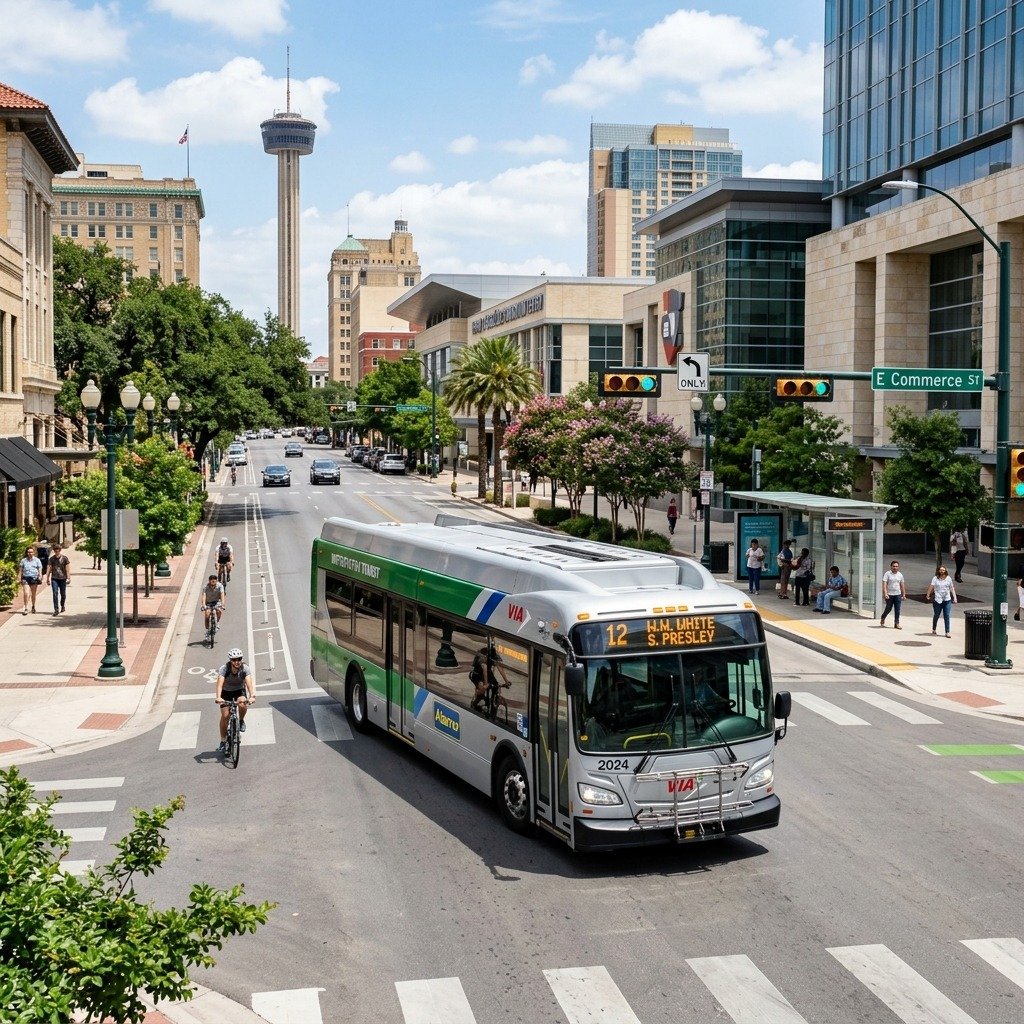
VIA Bus: Routes, Schedules, Fares and Services in San Antonio
VIA Metropolitan Transit is the public bus system serving San Antonio and Bexar County, Texas. It operates 95 routes, including Prímo limited-stop service, VIA Link on-demand rideshare, and VIAtrans paratransit. Base bus fare is $1.30, with day, weekly, and monthly passes available through the VIA goMobile+ app, goCard, or retail partners.
VIA Metropolitan Transit has grown well beyond a traditional city bus network. Today, it operates a layered mobility system that mixes fixed routes, limited-stop express service, and on-demand rideshare zones to move roughly 105,800 riders on an average weekday (APTA, Q2 2026). Understanding how these pieces fit together and which one applies to your trip makes a real difference in how quickly and affordably you get around San Antonio.
What Is VIA Metropolitan Transit?
VIA Metropolitan Transit is the public transportation authority for San Antonio, Texas, and surrounding Bexar County communities. Founded in 1977 and operational since 1978, VIA runs bus, paratransit, and rideshare services and carried roughly 30.7 million riders in 2025.
VIA serves San Antonio along with nearby municipalities including Alamo Heights, Balcones Heights, Castle Hills, Converse, Kirby, Leon Valley, Olmos Park, Shavano Park, and Terrell Hills. Some outlying Bexar County cities, such as Universal City and Schertz, aren’t directly served but are within reach of VIA’s Park & Ride facilities. VIA is governed by an 11-member Board of Trustees and led by President and CEO Jon Gary Herrera.
What Types of VIA Bus Service Are Available?
VIA offers four core service types: Prímo (limited-stop, every 12–15 minutes), Frequent (every 15–20 minutes), Standard (every 30+ minutes), and VIA Link (on-demand rideshare). Each serves a different purpose, from fast cross-town commutes to filling gaps where fixed routes don’t reach.
| Service Type | Frequency | Best For |
| Prímo | Every 12–15 minutes | Fast travel along major corridors (Fredericksburg, Military, Zarzamora) |
| Frequent | Every 15–20 minutes | High-ridership routes near downtown |
| Standard | Every 30–60+ minutes | Neighborhood and suburban coverage |
| VIA Link | On-demand, 15–30 min response | Areas without direct fixed-route service |
| VIAtrans | Scheduled 1+ day ahead | Curb-to-curb paratransit for riders with disabilities |
VIA also runs Park & Ride and special event service to venues like the Frost Bank Center, the Alamodome, and Fiesta San Antonio activities.
How Does VIA’s Bus Number System Work?
VIA bus numbers are grouped by type: 1–99 are radial routes to Downtown, 100–103 are Prímo limited-stop routes, 200–299 are late-night “Lineup” routes, 500–599 are crosstown routes, and 600–699 are circulator routes connecting to transit centers.
Knowing this structure helps you quickly identify what kind of trip a route number represents before you even check the schedule:
- Radial routes (1–99): Travel along major streets into and out of Downtown. Numbers increase clockwise from Interstate 10.
- Prímo routes (100–103): High-frequency, limited-stop service on heavy corridors like Fredericksburg Road (Route 100), Military Drive (Route 102), and Zarzamora Street (Route 103).
- Lineup routes (200–299): Late-night trips (10:30 p.m., 11:30 p.m., 12:30 a.m.) that continue outbound service from Downtown after regular routes end. The last two digits usually match the base daytime route.
- Crosstown routes (500–599): Connect major corridors without routing through Downtown, such as Route 501 (UTSA/Leon Valley) and Route 552 (Loop 410/W.W. White).
- Circulator routes (600–699): Local service linking neighborhoods to transit centers for example, Routes 611–619 all serve Kel-Lac Transit Center, and Routes 602–609 serve the South Texas Medical Center.
This system is rarely explained clearly elsewhere, but it’s genuinely useful: if you see a route number in the 600s, you already know it connects to a transit center rather than running Downtown.
How Do I Find a VIA Bus Number Near Me?
To find VIA bus numbers near your location, use the VIA goMobile+ app’s trip planner, Google Maps transit directions, or the Transit App, all of which show nearby stops and the routes that serve them. You can also check VIA’s printable system map for a full route overview.
For a faster option at a physical stop, look for the sign with a five-digit stop number. Text that number to 52020 to receive real-time arrival information for every route serving that stop no app download required. This is one of VIA’s most underused features, and it works from any basic mobile phone.
Where Can I Find VIA Bus Schedules and Routes Near Me?
VIA bus schedules and routes are available by route number at viainfo.net/routes, through the VIA goMobile+ app, or via Google Maps transit directions. Select your route from the dropdown menu on VIA’s site to view a printable schedule and map.
For a location-based search rather than a route-based one:
- Open Google Maps or the Transit App and enter your destination.
- Select “transit” directions to see which VIA routes connect your start and end points.
- Cross-check timing against the official downloadable schedule PDF for your route, since third-party apps can occasionally lag behind live schedule changes.
- If you’re near a stop with a posted number, text it to 52020 for a live arrival estimate.
Schedules change periodically the most recent system-wide update took effect August 24, 2026 so always confirm your specific route’s current schedule directly with VIA before relying on it for a time-sensitive trip.
What Are VIA’s Main Bus Routes?
VIA’s most heavily used routes are its three Prímo lines: Route 100 (Fredericksburg), Route 102 (Military), and Route 103 (Zarzamora). These operate on dedicated stations or enhanced stops with real-time signage and run more frequently than standard routes.
| Route | Corridor | Terminals | Peak Frequency |
| 100 | Fredericksburg Rd. | Medical Center T/C ↔ Ellis Alley Park & Ride | Every 15 min |
| 102 | Military Dr. | Kel-Lac Transit Center ↔ Brooks Transit Center | Every 12 min |
| 103 | Zarzamora St. | Madla Transit Center ↔ Crossroads Park & Ride | Every 12 min |
Beyond Prímo, popular crosstown and radial routes include Route 5 (connecting San Antonio International Airport to Downtown), Route 93 (serving UTSA and The Rim), and Route 501 (linking UTSA to Leon Valley). VIA operates 95 total routes across roughly 5,984 stops.
What Is a VIA Bus Station and How Does It Differ From a Regular Stop?
A VIA bus station typically refers to a Prímo station along Fredericksburg Road or a major transit center, both of which offer amenities beyond a standard curbside stop, such as real-time arrival signs, shelters, and at transit centers restrooms and ticket machines. Most VIA stops are simple curbside signs without these extras.
VIA operates 9 transit centers and 10 Park & Ride locations, including:
- Centro Plaza (909 W. Houston St.) VIA’s flagship hub with air-conditioning, free WiFi, ticket vending machines, restrooms, and real-time arrival displays.
- Madla Transit Center South Side hub connecting Routes 46, 51, 103, and 524.
- Kel-Lac Transit Center (7183 Highway 90 W.) serves Routes 76, 102, 552, and the 611–619 circulator group.
- Brooks Transit Center, Randolph Transit Center, North Star Transit Center, Ingram Transit Center, and Medical Center Transit Center each anchors a cluster of crosstown and circulator routes.
Along Fredericksburg Road, Prímo Route 100 boards from dedicated stations rather than standard bus stops, featuring arching shelters, WiFi, and digital next-bus signage. Routes 102 and 103 use “enhanced stops” with similar real-time information but a simpler design. If you’re planning a trip that requires transferring, arriving at a transit center rather than a basic stop generally gives you more amenities and connection options while you wait.
How Much Does It Cost to Ride VIA?
A single VIA bus ride costs $1.30 full fare or $0.65 reduced fare. Express buses cost $2.60. Day passes are $2.75, 7-day passes are $12, and 31-day passes are $38, all with 50% reduced-fare options for eligible riders. Transfers are free.
| Fare Type | Full Fare | Reduced Fare |
| Regular Bus | $1.30 | $0.65 |
| Express Bus | $2.60 | $1.30 |
| VIA Link | $1.30 | $0.65 |
| VIAtrans | $2.00 | $0.90 (child) |
| Day Pass | $2.75 | $1.35 |
| 7-Day Pass | $12.00 | $6.00 |
| 31-Day Pass | $38.00 | $19.00 |
| Annual Pass | $365.00 | — |
Reduced fares apply to children 5–13, seniors 62+, Medicare recipients, riders with qualifying disabilities, active-duty military, and students. Children under 4 ride free. Seniors and riders with limited mobility can ride for just $0.25 on weekdays between 9 a.m. and 3 p.m., and free all day on weekends with VIA ID.
For example, a commuter riding twice a day, five days a week, would spend $13.00 daily at full fare well above the $12 weekly pass. In that scenario, the 7-Day Pass is the more economical choice. Always confirm current pricing on VIA’s official fares page, as rates can change.
How Do I Pay for a VIA Bus Ride?
You can pay for VIA fares through the goMobile+ app (credit/debit card or cash-loaded account), a reloadable goCard, at a VIA Customer Service Center, or at retail partners including most H-E-B stores. Cash is also accepted directly on the bus, though exact change is required.
The goMobile+ app lets you buy and activate passes instantly, store multiple tickets for later use, and pay touch-free when boarding. There’s never an added fee for purchasing through the app. One practical scenario: if you’re new to VIA and unsure how many rides you’ll need, buying a single Day Pass through goMobile+ before boarding avoids the hassle of carrying exact change.
What Is VIA Link and How Do I Book a Ride?
VIA Link is an on-demand, shared rideshare service operating in designated zones where fixed bus routes don’t reach. Book a ride through the goMobile+ app, online, or by calling (210) 655-LINK, up to seven days in advance or on demand, with typical pickup within 15–30 minutes.
VIA Link currently operates in six zones: Naco Pass, Mainland, Madla, Randolph, Downtown, and Southeast. Each zone connects to a major transit hub for instance, the Madla Zone connects riders to Palo Alto College, South Park Mall, and Texas A&M San Antonio, while the Southeast Zone connects to Brooks Transit Center. Fares match standard bus pricing ($1.30 full, $0.65 reduced).
Example scenario: A rider in the Mainland Zone needing to reach UTSA Main outside of a fixed route’s hours could book a VIA Link ride through the app rather than waiting for an infrequent standard route often arriving faster than waiting for the next scheduled bus.
What Amenities Are Available on VIA Buses?
Quick answer: VIA buses offer free 4G LTE WiFi, wheelchair accessibility on all vehicles, bike racks (interior on 60-foot Prímo buses, exterior front-mounted on standard buses), and USB charging ports on newer Gillig models. Prímo buses also feature real-time arrival displays onboard.
- WiFi: Connect to the “VIAFreeWiFi” network on any bus or at any transit facility.
- Accessibility: All VIA buses are wheelchair accessible, and NaviLens codes at stops assist visually impaired riders using a smartphone app.
- Bikes: 60-foot Prímo buses hold up to three bikes inside; standard buses use an exterior front rack.
- Language support: VIA’s website and materials support English, Spanish, and ten additional languages.
How Do I Use the VIA goMobile+ App?
The VIA goMobile+ app allows riders to buy and activate bus passes, plan trips, track real-time bus arrivals, and pay touchlessly using a stored card or cash-loaded account. It’s available for iOS and Android and supports English and Spanish.
Common practical uses include buying a Day Pass before a one-off errand, checking real-time Next Bus information while walking to a stop, or storing multiple reduced-fare tickets for family members. Some user reviews note the app’s bus tracking can lag slightly behind actual bus location, so it’s wise to arrive at your stop a few minutes early rather than timing your arrival exactly to the app’s estimate.
Is VIA Reliable Compared to Other San Antonio Transportation Options?
VIA offers substantially lower costs than rideshare apps like Uber or Lyft for routine trips, with fares starting at $1.30 versus typical rideshare fares of $8–$20+ per trip, but it involves fixed schedules and stops rather than door-to-door pickup. VIA Link narrows this gap in zones where it operates by offering shared, on-demand rides.
| Factor | VIA Bus/Prímo | VIA Link | Rideshare (Uber/Lyft) |
| Typical cost | $1.30–$2.60 | $1.30–$0.65 | $8–$20+ |
| Pickup type | Fixed stop/station | Flexible within zone | Door-to-door |
| Wait time | Scheduled | ~15–30 min | Usually under 10 min |
| Booking | Walk-up or app | App, phone, or online | App only |
For budget-conscious, routine commuting, VIA’s fixed routes or Prímo service are typically the most economical. For last-mile trips in underserved neighborhoods, VIA Link offers a middle ground between a fixed bus stop and a private rideshare. For late-night or highly time-sensitive trips outside VIA’s service hours, rideshare remains the more flexible (if costlier) option.
What Should I Do If My VIA Bus Is Delayed or I Miss It?
If your VIA bus is delayed, check the goMobile+ app or text your stop number to 52020 for a live arrival update. If you miss a bus, most routes run every 15–60 minutes depending on service type, so check the next scheduled arrival rather than assuming a long wait.
For Lineup routes (200s) running late at night, VIA provides one additional pickup near Travis Park at 10:30 p.m., 11:30 p.m., and 12:30 a.m. as a final opportunity to reach outbound destinations. If a delay affects a planned transfer, VIA’s free transfer policy (valid 2.5 hours from issue) gives you flexibility to complete a multi-bus trip without paying twice, as long as you request the transfer when boarding.
Frequently Asked Questions
Does VIA charge extra for express or Prímo service?
Prímo service costs the same as regular bus fare ($1.30 full fare). Only Express bus routes, which are separate from Prímo, carry a higher $2.60 fare due to longer, limited-stop distances.
Can I transfer between VIA bus and VIA Link for free?
Transfers are free when requested at the time of boarding and are valid for 2.5 hours. This applies across regular bus, Prímo, and VIA Link services, though upgrading from local to express service requires paying the fare difference.
Do VIA fares change on holidays?
Fares stay the same on holidays, but schedules shift to a Saturday or Sunday service pattern depending on the holiday. For example, Thanksgiving Day runs on a Sunday schedule, while the day after follows a Saturday schedule.
Are VIA buses accessible for wheelchair users?
Yes. VIA operates more than 500 wheelchair-accessible buses across its fleet, and Prímo’s 60-foot vehicles include a self-restraining rear-facing wheelchair position in addition to standard forward-facing spaces.
How many people ride VIA each year?
VIA recorded approximately 30,665,700 rides in 2025, or an average of about 105,800 trips per weekday in the second quarter of 2026, according to American Public Transportation Association data.
Can students ride VIA for free?
Students, faculty, and staff at Alamo Colleges District, Our Lady of the Lake University, Texas A&M San Antonio, UTSA, and the University of the Incarnate Word can ride free by showing a school-issued goMobile pass through VIA’s U-Pass program.
What happens if I lose an item on a VIA bus?
VIA riders should contact VIA’s customer service line, the goLine at (210) 362-2020, to report and inquire about lost items. Confirm current lost-and-found procedures directly with VIA, since policies can be updated.
Is there a nonprofit discount for bulk VIA passes?
Yes. VIA’s Fare Assistance Program lets qualifying 501(c)(3) organizations serving low-income clients purchase monthly, weekly, and daily passes, along with VIA Link and VIAtrans tickets, at 25% below standard value. Organizations must apply through VIA’s Customer Relations Division.
Does VIA have future expansion plans I should know about?
Yes. Under the voter-approved “Keep San Antonio Moving” plan, VIA is building its first bus rapid transit line, the Green Line, running north-south along San Pedro Avenue, with construction underway and service targeted for 2028. A second line, the Silver Line, is projected for late 2030.
How do I know if a route runs less frequently on weekends?
Check the specific route’s schedule PDF on VIA’s website, since frequency varies by route and service type. Standard-service routes commonly drop to 40–60 minute or greater intervals on weekends, while Prímo and Frequent routes maintain shorter wait times daily.

One Comment