MBTA Bus: Routes, Schedules, Fares and Tracking
The MBTA operates 150 bus routes across Greater Boston, carrying roughly 335,300 riders each weekday. Local bus fare is $1.70 (or $0.85 reduced), and real-time tracking is available at mbta.com or through the Transit app. The system includes the five-route Silver Line, express buses, and a fully accessible, increasingly electric fleet.
What is the MBTA bus system?
The MBTA bus system is the bus network operated by the Massachusetts Bay Transportation Authority (MBTA), serving Boston and the surrounding Greater Boston area. It includes 150 routes, ranging from local neighborhood buses to express commuter routes and the five-route Silver Line bus rapid transit service, carrying about 335,300 riders on an average weekday.
The network traces back to horsecar and streetcar lines built between 1856 and the early 1900s. The MBTA itself was formed in 1964, absorbing several private suburban bus operators over the following two decades. Most routes today are local services that connect neighborhoods to subway stations, though 15 high-ridership “key routes” run at higher frequency throughout the day. Four routes (712, 713, 714, and 716) are operated by private contractors under contract to the MBTA, and two municipalities Lexington and Boston’s Mission Hill run their own subsidized circulator shuttles that connect with MBTA service.
What MBTA bus routes are available?
MBTA bus routes fall into several categories: local routes numbered 1 through 716, the five-route Silver Line (SL1–SL5, plus SLW), express buses that link suburbs to downtown Boston, and a limited-stop crosstown route (CT3). Route numbers are grouped roughly by geography, with the 100s, 200s, 400s, and 500s serving specific regions outside central Boston.
Here’s how the numbering breaks down:
| Route group | Examples | Type |
| Silver Line | SL1, SL2, SL3, SL4, SL5, SLW | Bus rapid transit |
| Crosstown | CT3 | Limited-stop |
| 1–99 | Routes 1, 22, 39, 66, 77 | Local (Boston & inner suburbs) |
| 100s–200s | Routes 111, 116, 220, 230 | Local (Chelsea, Lynn, Quincy areas) |
| 300s–500s | Routes 354, 426, 450, 501 | Express buses |
| 700s | 712, 713, 714, 716 | Privately operated commuter routes |
The MBTA is also in the middle of a major Bus Network Redesign, approved in December 2022, which increases overall service by 25% and doubles the number of high-frequency routes. Changes are rolling out in phases through 2028: the first phase launched in December 2024 in areas northeast of Boston, and a second round of changes took effect in April 2026. Because routes are actively changing, riders planning a trip on an unfamiliar route should confirm current service on mbta.com before heading out.
How do I check the MBTA bus schedule?
You can check the MBTA bus schedule for any route at mbta.com/schedules/bus by selecting your route number, or by using the Trip Planner tool to enter your origin and destination. Schedules show timetables, stop-by-stop arrival times, and any active service alerts affecting that route.
Each route’s schedule page also links to a system map and shows fare information relevant to that specific route. Since the MBTA is actively rolling out network redesign changes and periodic seasonal service updates (the most recent being the Fall 2026 service changes), it’s worth checking a route’s schedule page shortly before you travel rather than relying on a printed timetable or an old bookmark.
How does the MBTA bus tracker work?
The MBTA bus tracker shows the real-time location of every bus in the system and predicts arrival times at each stop. You can access it at mbta.com, through the Trip Planner, or via third-party apps like Transit, all of which pull from the same live MBTA data feed.
The MBTA has invested specifically in improving prediction accuracy through its Better Bus Tracking and Predictions initiative, which uses instant vehicle location data to generate more reliable arrival estimates than schedule-based guesses alone. In practice, this means that if you’re standing at a stop and a bus shows as “3 minutes away,” that estimate reflects the bus’s actual current position rather than just its scheduled time. For riders without a smartphone handy, many key bus stops also display digital countdown signs showing the same real-time data.
What are the MBTA bus fares?
A local MBTA bus ride costs $1.70 with a CharlieCard, CharlieTicket, contactless payment, or cash, and $0.85 with a reduced fare card. As of September 1, 2026, on a pilot basis, Express Bus fares match Local Bus fares at $1.70, and Express Bus passes are no longer sold separately.
| Fare type | Price |
| Local bus, one-way | $1.70 |
| Reduced fare, one-way | $0.85 |
| Express bus, one-way (pilot) | $1.70 |
| 1-Day Pass | $11.00 |
| 7-Day Pass | $22.50 |
| Monthly Local Bus Pass | $55.00 |
| Monthly LinkPass (bus + subway) | $90.00 |
Note that SL1, SL2, and SL3 (the Silver Line’s Waterfront routes) are priced as subway fares ($2.40), not bus fares, while SL4 and SL5 charge the standard local bus fare. As of the September 2026 pilot, riders transferring between subway, bus, and ferry within a two-hour window pay only the cost of the highest-priced service, as long as they use the same payment method throughout.
How do I pay for an MBTA bus?
You can pay your MBTA bus fare with a CharlieCard, CharlieTicket, contactless payment (tapping a credit card or smartphone), cash, or an EBT card loaded onto a CharlieCard or CharlieTicket. Each method has different trade-offs depending on how often you ride.
- CharlieCard: Best for frequent riders; reusable, manageable online, and works on subway, bus, and Silver Line.
- CharlieTicket: Best for visitors; available at any subway station and can hold cash value or passes.
- Contactless payment: Convenient for occasional riders, but not compatible with daily, weekly, or monthly passes.
- Cash: Accepted onboard, up to $20, with exact change encouraged since fare boxes don’t return change.
- EBT card: Usable at fare vending machines or MBTA retail locations to load a CharlieCard or CharlieTicket.
When boarding, listen for the fare box beep: one beep confirms a CharlieCard payment, two beeps confirm a CharlieTicket, and three beeps mean the payment didn’t go through. If that happens, try again or head to a fare vending machine to reload your card.
One detail that trips up new riders: monthly passes can only be purchased between the 15th of the prior month and the 14th of the current month, and Auto-Pay sign-ups must be completed by the 22nd of the prior month to take effect on time.
Who qualifies for reduced MBTA bus fares?
Students, seniors, people with disabilities, and low-income young adults can qualify for reduced MBTA bus fares of $0.85 per ride. Military personnel, people who are legally blind, and children age 11 and under ride completely free.
Riders who qualify need to apply for a reduced fare card, which can then be loaded like a standard CharlieCard. For those who cannot use fixed-route buses or subway service due to a disability, The RIDE offers door-to-door paratransit service, with reduced fares available to riders enrolled in the senior or income-eligible programs.
What recent improvements has the MBTA made to bus service?
Recent MBTA bus improvements include the Better Bus Project, which partners with more than 50 municipalities and MassDOT to keep 1,000 buses running for roughly 300,000 daily riders, along with continued rollout of dedicated bus lanes, queue jumps, and transit signal priority under the Transit Priority Strategy.
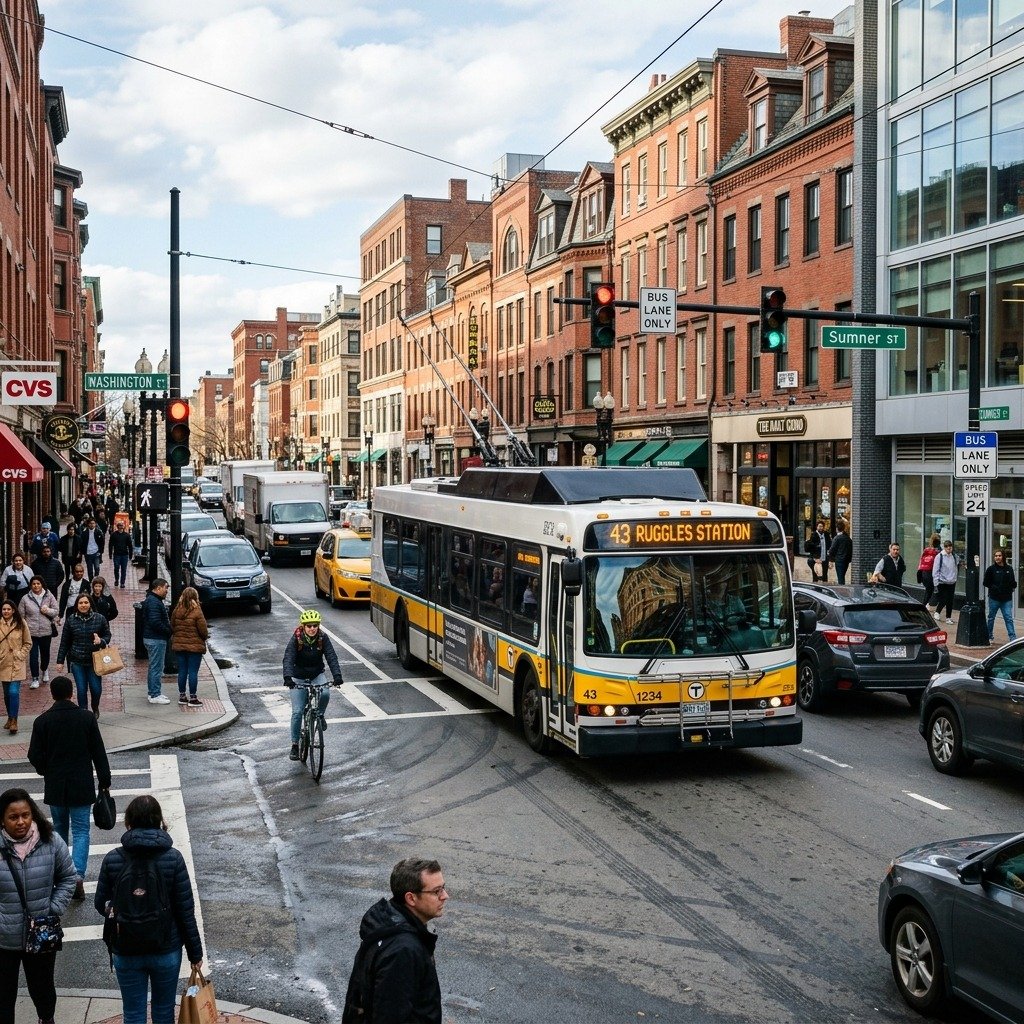
Specific 2026 developments include full funding for an upgraded Arborway Bus Facility (announced March 2026), expanded bus service around Houghton’s Pond and Hingham/Hull, and service updates tied to World Cup 2026 matches in the Boston area. The MBTA has also opened multiple sections of dedicated bus lanes in recent years, including New England’s first center-running bus lanes on Columbus Avenue, which help buses bypass car traffic on some of the system’s busiest corridors.
Is the MBTA bus fleet going electric?
Yes. Massachusetts state law requires the MBTA to purchase only zero-emission buses after 2029 and to fully electrify its bus fleet by 2040. The MBTA has already ordered more than 100 battery-electric buses, with some funded in part by Volkswagen “Dieselgate” settlement money.
The current active fleet runs on a mix of diesel, diesel-electric hybrid, and compressed natural gas (CNG) propulsion, but new battery-electric buses are entering service at garages like North Cambridge, with additional electric buses planned for the new Quincy Bus Maintenance Facility opening in 2027. Every MBTA bus, regardless of fuel type, is already low-floor and accessible, with fold-out ramps for riders using wheelchairs or mobility devices.
Frequently Asked Questions
How many bus routes does the MBTA operate?
The MBTA operates 150 bus routes throughout Greater Boston, including local routes, the five-route Silver Line, express buses, and a crosstown route, according to current MBTA route data.
Can I use a contactless card to pay for a monthly MBTA bus pass?
No. Contactless payment works for single rides on bus, subway, Silver Line, and ferry, but it is not compatible with 1-day, 7-day, or monthly passes, which require a CharlieCard or CharlieTicket.
What happens if my CharlieCard doesn’t work on the bus?
If the fare box beeps three times, your payment wasn’t accepted, either due to a read error or insufficient balance. Try tapping again, or add value at the next fare vending machine.
Are MBTA buses wheelchair accessible?
Yes. The entire MBTA bus fleet consists of low-floor buses equipped with fold-out ramps, making every route accessible to riders using wheelchairs or other mobility devices.
Do MBTA bus fares differ by route?
Most local buses cost a flat $1.70, but Silver Line routes SL1, SL2, and SL3 charge the higher subway fare of $2.40, while SL4 and SL5 charge the standard local bus fare.
Can I transfer between MBTA bus and subway for free?
As of a September 2026 pilot, riders can make unlimited transfers between bus, subway, and ferry within a two-hour window and pay only the highest-priced fare, provided they use the same payment method throughout.
Is the MBTA bus network changing in 2026?
Yes. The MBTA’s Bus Network Redesign is rolling out in phases through 2028, with a second round of route changes implemented in April 2026 and additional Fall 2026 service changes announced separately.
How do I pay an MBTA bus fare with cash?
Tell the driver you’re paying in cash and insert up to $20 in coins or bills into the onboard fare box. Exact change is encouraged, since fare boxes do not return change.
Who rides for free on MBTA buses?
Military personnel, people who are legally blind, and children age 11 and under ride MBTA buses for free, per current MBTA reduced fare policy.
Are MBTA buses becoming electric?
The MBTA is transitioning its fleet to battery-electric buses, with state law requiring zero-emission purchases after 2029 and a fully electrified fleet by 2040.