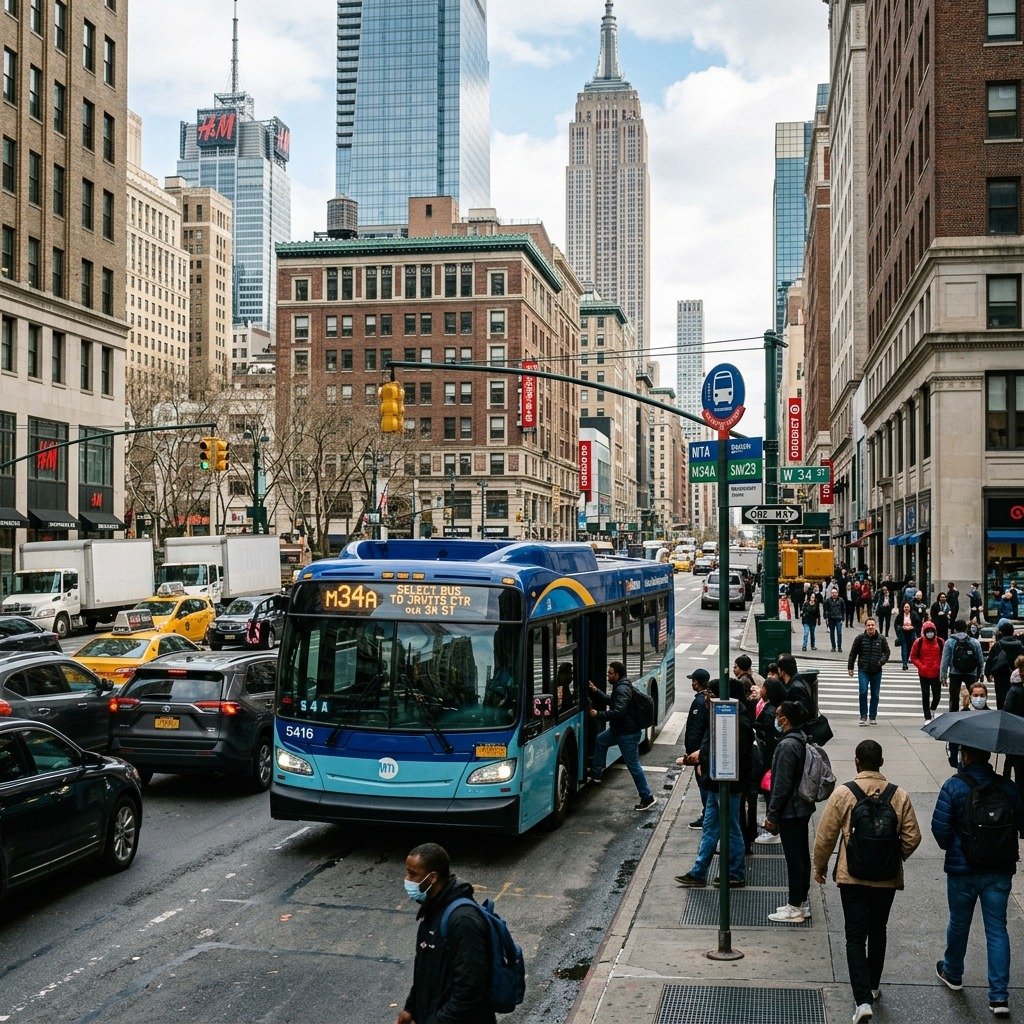
MTA Bus: Routes, Fares, Tracker & Schedules 2026
MTA Bus refers to the bus network operated by New York City’s Metropolitan Transportation Authority, covering 345 routes across the five boroughs. As of January 2026, the base local fare is $3.00, express fare is $7.25, and riders can track buses in real time using BusTime or the MYmta app. Fares are automatically capped under OMNY.
New York City’s bus network moves more people through more neighborhoods than almost any surface transit system in the country. Whether you’re catching a local bus down Utica Avenue or riding an express coach from Staten Island into Manhattan, understanding how MTA Bus works from fares to tracking tools makes every trip smoother.
What Is the MTA Bus System?
MTA Bus is the umbrella term for bus service operated across New York City by two divisions: MTA New York City Bus (formerly the New York City Transit Authority and MaBSTOA) and MTA Bus Company, which absorbed several former private bus operators in Queens, the Bronx, and Brooklyn. Together, these divisions run the largest bus fleet in the United States.
- Total network: 345 routes, including 248 local, 77 express, and 20 Select Bus Service (SBS) routes
- Fleet size: 5,840 buses
- MTA Bus Company subsidiary alone: 90 routes (44 local, 43 express, 3 SBS) covering 812 route miles
Because the system is so large, riders often need more than a printed timetable real-time tools have become essential to navigating it reliably.
What Types of MTA Bus Service Are Available?
MTA operates five distinct bus service types, each identified by different bus stop sign colors and stopping patterns. Local buses make every stop, while Limited, Rush, SBS, and Express services skip stops to move faster along busy corridors or between boroughs.
| Service Type | Stop Pattern | Stop Sign Color | Best For |
| Local | Every stop | Blue | Short neighborhood trips |
| Limited (LTD) | Fewer stops on local routes | Purple | Mid-distance travel |
| Rush | Local near transit hubs, limited elsewhere | N/A | Areas far from subway access |
| Select Bus Service (SBS) | Off-board payment, dedicated lanes | Turquoise | High-traffic corridors |
| Express | Nonstop segments between boroughs and Manhattan | Green | Long commutes into Manhattan |
Rush service is the newest addition, introduced during the 2025 Queens Bus Network Redesign to blend local coverage with faster travel near major hubs.
What Are MTA Bus Fares in 2026?
The base MTA local bus fare is $3.00, up from $2.90, following fare adjustments the MTA Board approved for January 2026. Express bus fares rose to $7.25. OMNY’s 7-day fare cap is now permanent, meaning riders pay for 12 rides in a rolling 7-day window and ride free for the rest of that period.
| Fare Type | Cost |
| Local, Limited, Rush, SBS | $3.00 |
| Reduced fare | $1.50 |
| Express bus | $7.25 |
| 7-day cap (local/subway) | Max $35/week |
| 7-day cap (express + local + subway) | Max $67/week |
Riders can pay by tapping a contactless credit or debit card, smartphone wallet, smartwatch, or OMNY card at the reader near the driver. Cash is still accepted with exact change, though the MTA plans to phase out coin payments on buses later in 2026 as tap-and-ride becomes the standard.
How Do I Check the MTA Bus Time Schedule?
The MTA bus time schedule for any route is available on the official MTA website or MYmta app by entering a route number or intersection. Schedules show planned departure times but can shift due to traffic, so real-time tracking tools typically give more accurate arrival estimates than the static timetable alone.
When reading a printed or digital schedule, check whether it applies to weekday, Saturday, or Sunday/holiday service, since frequency often drops on weekends. Overnight schedules also run less frequently, which is why the MTA’s Request-A-Stop feature (explained below) matters most late at night.
How Does the MTA Bus Tracker Work?
BusTime, accessible at bustime.mta.info, uses GPS receivers installed on MTA buses to show each vehicle’s live location and predict arrival times at nearby stops. If a bus icon appears on the map, that’s a real-time position; if only a time is listed without an icon, the system is relying on the scheduled timetable instead.
Occasionally, a bus tracker shows a vehicle that never arrives a phenomenon riders call “ghosting.” This typically happens when a bus’s GPS transmitter malfunctions or the bus gets rerouted due to an emergency or detour. If this happens, texting your bus stop code to 511123 provides a reliable backup, since it doesn’t depend on a data connection.
What Are the Different MTA Bus Routes?
MTA bus routes are named using a letter prefix tied to the borough where they primarily operate, followed by a route number. This naming convention helps riders quickly identify which part of the city a bus serves before checking a map.
- B – Brooklyn
- Bx – The Bronx
- M – Manhattan
- Q – Queens
- S – Staten Island
- BM, BxM, QM, SIM – Express routes ending in Manhattan
According to 2025 MTA ridership data, the busiest local routes include the M15 Local/SBS in Manhattan (nearly 12 million annual riders), Q58 in Queens, and Bx12 Local/SBS in the Bronx each carrying more than 6 million riders a year.
Is There an MTA Bus Time App?
Yes, MYmta is the MTA’s official app for tracking buses, checking bus time schedules, and receiving service alerts. Third-party apps like Google Maps and Citymapper also pull directly from the MTA’s live GPS data feed, so all three sources generally show similar real-time arrival information.
For riders without a smartphone or data plan, MTA Bus Time also offers a text-based option: sending a bus stop code to 511123 returns an automated reply listing the next few scheduled arrivals.
Are MTA Buses Wheelchair Accessible?
All MTA buses are equipped with ramps or lifts and are fully accessible to riders using wheelchairs or mobility scooters. Drivers secure mobility devices once boarded, and priority seating near the front is reserved for passengers with disabilities and senior citizens.
Between 10 p.m. and 5 a.m., riders can also use Request-A-Stop, asking the driver to let them off at a safe location between official stops. This service isn’t available on SBS routes, nonstop express segments, limited-stop routes, or overnight shuttle buses.
Is the MTA Transitioning to Electric Buses?
The MTA has committed to converting its entire 5,840-bus fleet to zero-emission vehicles by 2040, but a 2026 audit from the New York State Comptroller found this goal is currently at risk. Delivery delays, higher costs, and reliability issues with early electric buses have slowed the rollout significantly.
The MTA received its first 15 electric buses in 2019 and 60 more in 2024. In January 2025, it ordered 265 additional zero-emission buses, but by mid-2025 only one had been delivered, prompting the agency to scale back its next order from 1,000 buses to 500. Hydrogen fuel-cell buses are also being tested at the Gun Hill Road Depot in the Bronx, using hydrogen produced from sustainable hydropower.
Frequently Asked Questions
Does the MTA bus fare change based on distance traveled?
No. Local, Limited, Rush, and SBS buses all charge the same flat $3.00 fare regardless of distance, while express buses charge a flat $7.25 fare. Distance does not affect the base price.
Can I transfer from a bus to the subway for free?
Yes. A single OMNY tap or MetroCard swipe allows a free transfer between buses or from a bus to the subway within a two-hour window.
What happens if my bus never shows up on the tracker?
This is commonly called “ghosting,” usually caused by a failed GPS transmitter or an unexpected reroute. Texting your stop code to 511123 provides a reliable alternative arrival estimate.
Are MTA buses cash-only if I don’t have OMNY?
No, but options are narrowing. Cash is still accepted with exact change, though the MTA plans to phase out coin payments on buses later in 2026 as tap-and-ride becomes mandatory.
How much did MTA bus ridership grow in 2025?
NYC Transit bus ridership rose 8.1% year-over-year in 2025, reversing a 4.2% decline seen between 2023 and 2024, according to MTA ridership data.
What is the busiest MTA bus route?
The M15 Local/SBS in Manhattan was the busiest route in 2025, carrying nearly 12 million annual riders, according to MTA’s published ridership rankings.
Is Select Bus Service faster than a local bus on the same corridor?
Yes, in most cases. SBS routes use off-board fare payment and dedicated lanes, which reduce the time buses spend idling at each stop compared to standard local service.
Will the MTA’s bus fleet be fully electric soon?
Not by its original target. A 2026 state audit found the MTA is unlikely to meet its 2040 zero-emission goal due to manufacturer delays, high costs, and reliability issues with early electric bus models.
Can I request a bus stop outside of designated locations?
Only overnight. Request-A-Stop is available from 10 p.m. to 5 a.m. on local and express (drop-off) routes, but not on SBS, limited-stop, or nonstop express segments.
Does the MTA app show the same real-time data as BusTime?
Yes. The MYmta app and BusTime both draw from the same GPS-based tracking system, so arrival estimates should match closely between the two.

One Comment