WMATA Bus: Routes, Fares, Schedules & Live Tracking
WMATA’s Metrobus network serves Washington, D.C., Maryland, and Virginia with over 120 routes, real-time tracking through busETA and Metro Pulse, and standard fares of $2.25 per ride. The system underwent its first major redesign in 50 years the Better Bus Network which launched June 29, 2025, reshaping routes across the entire region.
Getting around the DMV without a car often comes down to understanding one system: Metrobus. Whether you’re commuting into downtown D.C., connecting to Metrorail, or riding late at night after a shift, WMATA’s bus network covers ground that trains simply don’t reach. But between fare types, transfer rules, real-time tracking tools, and a recent route overhaul, the system has more moving parts than it first appears.
What Is WMATA Bus (Metrobus) and Where Does It Operate?
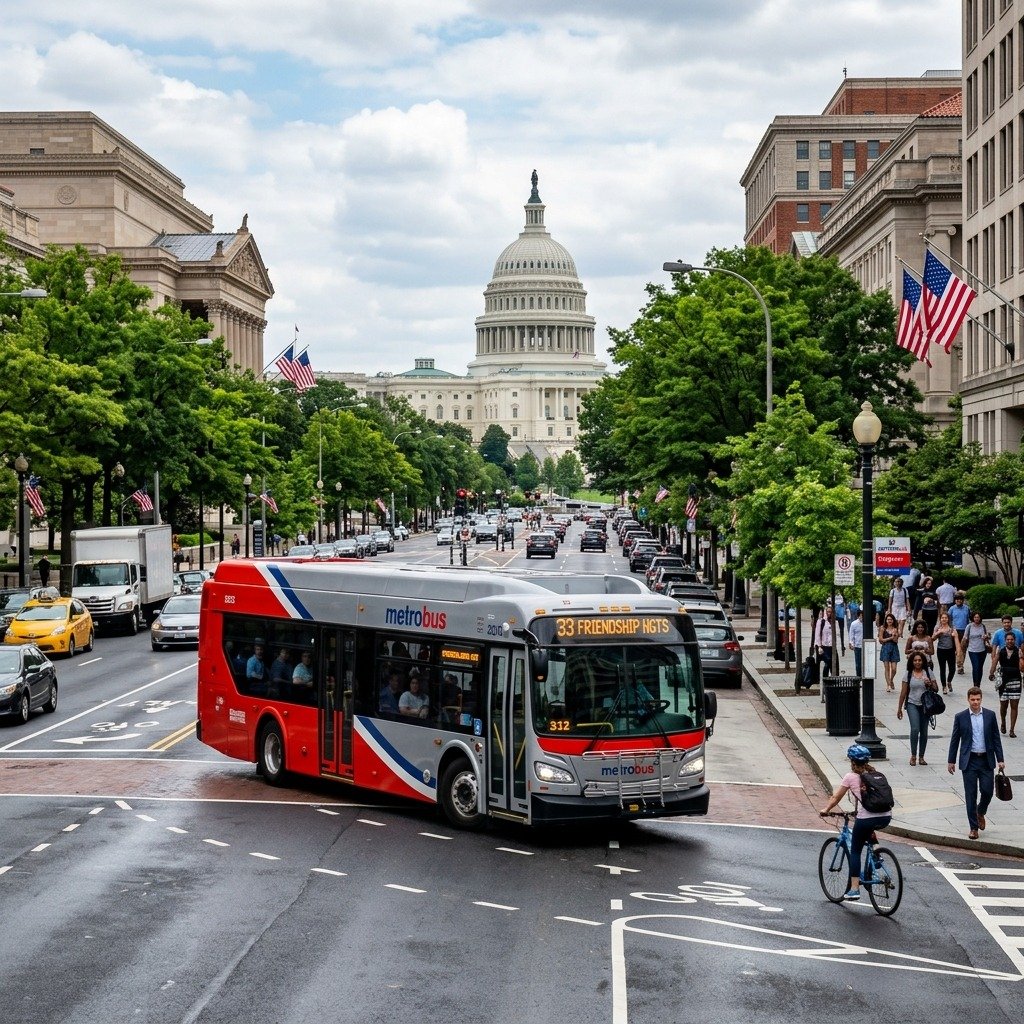
Metrobus is the bus service operated by the Washington Metropolitan Area Transit Authority (WMATA), serving Washington, D.C., suburban Maryland, and Northern Virginia. It operates more than 120 routes that connect neighborhoods to Metrorail stations, employment centers, and regional destinations across the DMV.
Routes are named by a letter indicating the area they serve, which makes the system easier to navigate once you know the code:
| Letter | Area Served |
| A | Arlington / Alexandria |
| C | Crosstown D.C. |
| D | Downtown D.C. |
| F | Fairfax City, Fairfax County, Falls Church |
| M | Montgomery County |
| P | Prince George’s County |
| X (suffix) | Limited-stop service |
Many Metrobus routes are designed to feed directly into Metrorail stations, so you can start a trip by bus and finish it by train (or vice versa) using the same SmarTrip card.
How Do I Find My Next WMATA Bus?
To find your next WMATA bus, use busETA at buseta.wmata.com, where you can search by stop code, route number, or street address to see real-time arrival predictions. Every physical bus stop displays a unique stop code, which you can enter directly into busETA or text to get live updates without downloading an app.
If you prefer an app-based experience, WMATA’s Metro Pulse app was redesigned to simplify how riders check bus and train arrivals, service alerts, and trip planning in one place. Both tools pull from the same real-time vehicle data, so the difference mainly comes down to your personal preference for web versus app.
Ways to check your next bus:
- busETA website: Enter a stop code, route, or address at buseta.wmata.com
- Metro Pulse app: Download for iOS or Android for real-time arrivals and alerts
- Call or text: 202-GO-METRO (202-466-3876) for live customer assistance
- Posted stop codes: Found on the physical sign at each bus stop
What Is WMATA busETA and How Accurate Is It?
WMATA busETA is the transit authority’s real-time bus arrival tool, showing live predictions based on GPS data from vehicles currently in service, rather than fixed schedule times. It’s the most reliable way to check whether a bus is on time, delayed, or not currently running due to a service disruption.
Because busETA relies on live GPS positioning, its estimates are generally more accurate than a printed timetable, especially during periods of heavy traffic, weather events, or planned detours. If a route shows no real-time prediction, it may indicate a temporary outage in a bus’s tracking equipment in that case, use Trip Planner on wmata.com for the scheduled time instead, and consider confirming with the busETA stop code again closer to your departure.
How Much Does It Cost to Ride WMATA Bus?
A standard Metrobus ride costs $2.25 for regular and limited-stop (X) routes, or $1.10 with a reduced fare. The four express routes F19, F28, F81, and F83 cost $4.80, or $2.40 reduced. Fares apply the same way regardless of trip distance or time of day, unlike Metrorail’s variable pricing.
| Fare Type | Regular | Reduced |
| Regular & limited-stop (X) routes | $2.25 | $1.10 |
| Express routes (F19, F28, F81, F83) | $4.80 | $2.40 |
You can pay with a SmarTrip card, a contactless credit or debit card tapped at boarding, or exact change in cash (bus operators cannot make change). Up to two children age 4 and younger ride free with a paying adult, and DC public, private, charter, and parochial school students ride free through the DC Kids Ride Free program.
Transfer discounts (SmarTrip and contactless payment only):
- Bus to bus: free, unlimited transfers within 2 hours
- Bus to rail or rail to bus: $2.25 discount within 2 hours
- Transfers to Express routes: the $2.25 discount doesn’t cover the full express fare step-up
If you ride frequently, a pass may cost less than paying per trip. WMATA’s 7-Day Regional Bus pass runs $13.50, while a 7-Day unlimited bus-and-rail pass costs $60.75. Since these prices and route eligibility can change, confirm current pass pricing on wmata.com before purchasing.
What Are WMATA’s Current Bus Routes?
WMATA operates its bus network under the Better Bus Network, a full redesign that launched June 29, 2025 the first major overhaul of the system in 50 years. The redesign changed route numbers, names, and coverage areas across D.C., Maryland, and Virginia, so riders using older route numbers may need to check WMATA’s updated system maps.
As part of ongoing refinements, WMATA added a new A29 route connecting Alexandria to Metro Center and updated service on 50 additional Metrobus routes in December 2025. Because route networks continue to evolve, always check WMATA’s current system maps or Trip Planner rather than relying on an older printed map or a previous route number you may have used before.
Where to find current route information:
- System Maps page (wmata.com) for PDF maps by jurisdiction
- Trip Planner for point-to-point route suggestions
- Frequent Service maps for routes running every 12–20 minutes, 7 am–9 pm
What Is WMATA’s Bus Schedule?
WMATA bus schedules generally follow Metrorail’s operating hours: Monday through Thursday from 5 am to midnight, Friday from 5 am to 2 am, Saturday from 6 am to 2 am, and Sunday from 6 am to midnight. Exact first and last bus times vary by route, so use Rider Tools on wmata.com to confirm specific departure times for your line.
Outside these standard hours, WMATA also runs 24/7 bus service on 14 high-ridership D.C. routes, launched in December 2023 to support essential workers and nightlife across the city.
Routes with 24/7 service: A6, A8, B2, H4, S2, V2, W4, X2, 32, 33, 52, 70, 80, 92
Between 9 pm and 7 am, these routes run every 20 minutes or better. Riders on these routes traveling between 9 pm and 5 am can also request a Courtesy Stop between designated stops, allowing the driver to let them off closer to their destination at the operator’s discretion.
What Transit Benefits Does WMATA Offer?
WMATA participates in SmartBenefits, a pre-tax commuter benefit program that lets employees pay for Metrobus and Metrorail fares using pre-tax income, while employers avoid payroll taxes on the amount provided. There’s no fee for employers to join, and employees can save close to $1,800 annually depending on their benefit level.
For a transit-only benefit of $300 per month, an employee earning a typical salary could save roughly $1,310 annually in combined federal, state, and payroll taxes, based on WMATA’s published example. Employers offering the same benefit can reduce their own payroll tax burden by several hundred dollars per employee, per year. The IRS sets a monthly pre-tax limit for combined transit and vanpool benefits, currently $340 per month confirm the current-year limit with WMATA or IRS Publication 15-B, since this figure adjusts periodically.
SmartBenefits funds load directly onto a registered SmarTrip card and can also be allocated toward vanpools, MARC, VRE, MTA Commuter Bus, and Metro Access for riders who use those services alongside Metrobus.
Are There Reduced Fares for Seniors, Riders with Disabilities, or Low-Income Riders?
Yes. WMATA offers a 50% fare reduction on Metrobus and Metrorail for riders age 65 and older, people with qualifying disabilities, and Metro Lift enrollees. Metro Lift is a free enrollment program for D.C., Maryland, and Virginia residents currently receiving SNAP benefits, and it typically activates on a SmarTrip card within 48 hours of online enrollment.
Reduced fare programs at a glance:
- Senior SmarTrip: 50% off for riders 65+
- Disability reduced fare: 50% off for qualifying riders
- Metro Lift: 50% off for active SNAP recipients in DC, MD, or VA
- DC Kids Ride Free: Free rides for DC-enrolled students
These programs can’t be combined on the same SmarTrip card for example, Metro Lift and Senior SmarTrip discounts don’t stack, since both already provide the same 50% reduction.
Can I Bring a Bike or Stroller on WMATA Bus?
Every Metrobus is equipped with a front-mounted rack that holds up to two bicycles, and bikes are welcome on board at no extra charge. Strollers are generally allowed as long as they can be safely stowed and don’t block the aisle or doorways, though space may be limited during peak hours.
Where Can I Park to Access Metrobus or Metrorail?
WMATA operates parking facilities at 51 Metrorail stations, many of which also serve as major bus transfer points. Parking is free on weekends and federal holidays at Metro-operated lots, while weekday fees typically apply from around 7:30 am until late evening, depending on the station.
Frequently Asked Questions
Does WMATA bus fare change based on distance or time of day?
No. Unlike Metrorail, standard Metrobus fares are flat-rate $2.25 regardless of distance or time of day, except for the four express routes, which cost $4.80.
Can I use a regular credit card to pay for Metrobus?
Yes. WMATA’s Tap. Ride. Go. program lets riders tap a contactless credit or debit card directly at boarding, without needing to register or purchase a SmarTrip card first, though only full fares apply.
What happens if the bus driver can’t make change for cash?
Bus operators cannot make change, so cash-paying riders must have exact fare ready. Using a SmarTrip card or contactless payment avoids this issue entirely.
Is there a limit to how many free bus-to-bus transfers I can make?
No set limit exists on the number of transfers, but each one must occur within a 2-hour window from your initial tap to qualify as free.
Do WMATA reduced fare programs apply to Metro Access?
No. Metro Lift and other 50% reduced fare programs apply to Metrobus and Metrorail only; they don’t extend to Metro Access paratransit fares.
How do I know if my bus route was renamed in the 2025 redesign?
Check WMATA’s current System Maps or Trip Planner, since the Better Bus Network renamed and restructured routes across all three jurisdictions starting June 29, 2025.
Can I request a stop between two official bus stops at night?
Yes, but only on 24/7 routes and only between 9 pm and 5 am. WMATA calls this a Courtesy Stop, and it’s granted at the bus operator’s discretion for safety reasons.
Do unused SmartBenefits roll over to the next month?
It depends on your employer’s policy. WMATA states unused benefits are either credited back to the employer’s account or rolled over for future use, based on employer settings.
Is Metrobus accessible for wheelchair users?
Yes. All Metrobuses are fully accessible, along with every Metrorail station, so riders using wheelchairs or with other mobility needs can use the system without needing to request special accommodations in advance.
Does WMATA charge extra for the four express bus routes?
Yes. F19, F28, F81, and F83 charge $4.80 per ride ($2.40 reduced), roughly double the standard Metrobus fare, reflecting their longer-distance, limited-stop service.