Miami Dade Metrobus: Routes, Fares, Tracker & Passes
Miami-Dade Metrobus operates 95+ routes and 800+ buses across Miami-Dade, Broward, and Monroe Counties, carrying roughly 171,600 weekday riders. Standard fare is $2.25 per trip, with free transfers to Metrorail. Riders can track buses live using the GO Miami-Dade Transit app, and seniors, veterans, and low-income residents may qualify for free or discounted passes.
What is Miami-Dade Metrobus?
Metrobus is the public bus network operated by Miami-Dade Transit, serving Miami-Dade County along with parts of Broward and Monroe Counties. Founded in 1960, the system runs more than 95 routes using a fleet of over 800 buses, connecting riders to major shopping centers, hospitals, schools, and cultural destinations across Greater Miami.
Metrobus operates 365 days a year, though individual route schedules vary. Some routes, including 3, 11, 27A, 77, 100, and 602, run 24 hours a day, while most others operate roughly between 4:30 a.m. and 1:30 a.m. It’s worth checking the specific route schedule before planning a late-night trip, since not every route offers round-the-clock service.
What routes does Miami-Dade Metrobus cover?
Metrobus routes reach from Miami Beach and Key Biscayne to Homestead, Florida City, and even Marathon in the Florida Keys, plus connections into Broward County. Routes are divided into local, circulator, limited-stop (MAX), express, and Metro Express (BRT) categories, giving riders multiple ways to reach the same destination depending on how many stops they want to make.
A few routes stand out for visitors and commuters alike:
| Route | Connects | Type |
| 150 Miami Beach Airport Express | South Beach to Miami International Airport | Express/limited-stop |
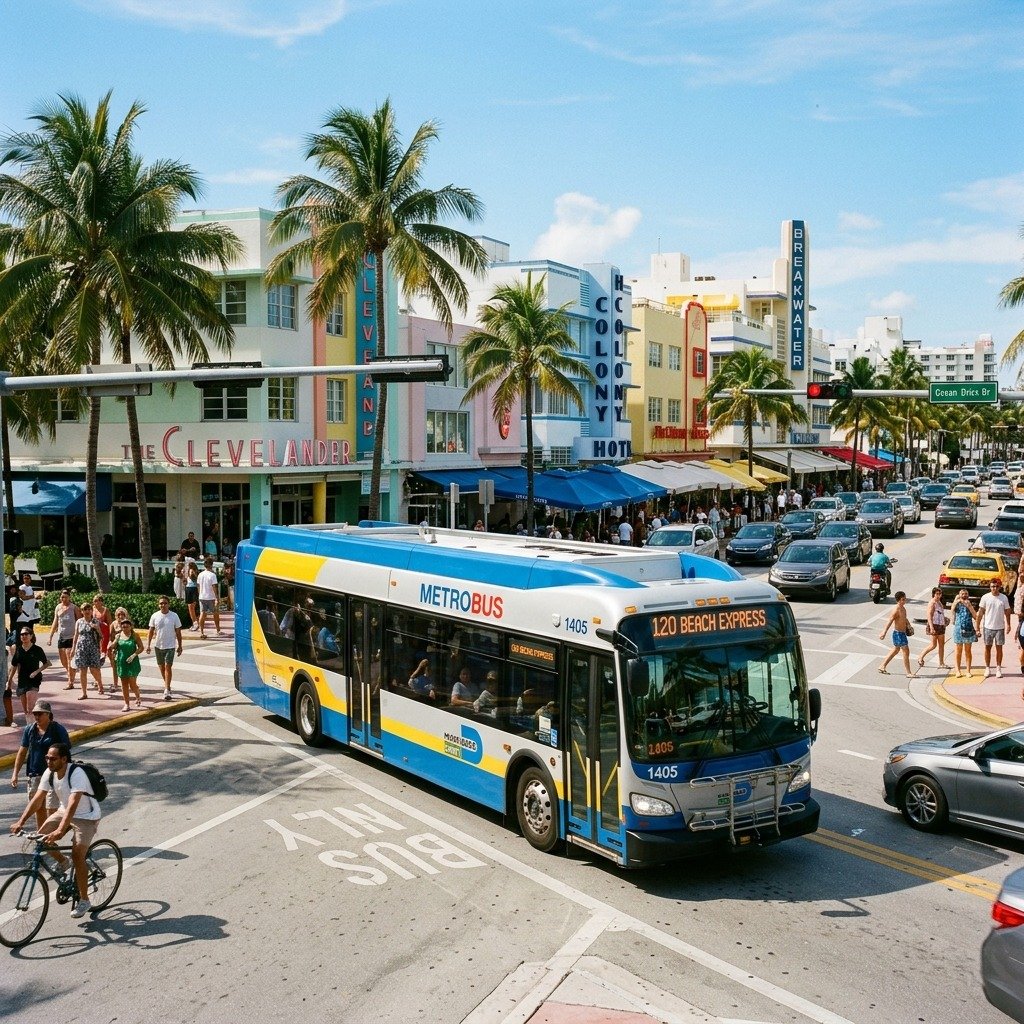
| 120 (South Beach Local) | South Beach to Aventura Mall via Downtown | Local circulator |
| 601 Metro Express | Florida City to Dadeland South Metrorail station | BRT |
| 301 Dade-Monroe Express | Florida City to Marathon in the Keys | Express |
| 100 | Downtown Miami to Aventura Mall via Miami Beach | Local, 24-hour |
Because Metrobus connects directly with Metrorail and Metromover, many trips involve a bus-to-rail transfer. That connectivity matters when comparing Metrobus to alternatives: Broward County Transit picks up where Metrobus routes 95 and 301 leave off at the county line, and municipal trolleys (Coral Gables, Doral, Hialeah, and others) fill in local gaps that county routes don’t cover directly.
Miami Dade Metrobus cost: how much does a ride cost?
A standard Metrobus ride costs $2.25 per trip, with a discounted fare of $1.10 for eligible riders such as Medicare recipients, people with disabilities, and K-12 students. Riders using contactless payment benefit from fare capping, meaning total daily costs never exceed $5.65, no matter how many trips are taken.
Here’s the full breakdown of current fares:
| Fare Type | Full Fare | Discount Fare |
| Metrobus (single trip) | $2.25 | $1.10 |
| Inter-County Express (Routes 301, 302) | $2.65 | $1.30 |
| Bus-to-Bus Transfer (within 3 hours) | Free | Free |
| Bus-to-Rail / Rail-to-Bus Transfer | Free | Free |
| Bus-to-Express Bus Transfer | $0.95 | $0.45 |
| 1-Day Pass | $5.65 | $2.80 |
| 7-Day Pass | $29.25 | $14.60 |
| 1-Month Pass | $112.50 | $56.25 |
| College/Adult Ed Monthly Pass | $56.25 |
A practical example: a commuter making two round trips a day (four boardings) on a contactless card pays no more than $5.65 total for that day once fare capping kicks in, which usually works out cheaper than paying cash for every ride. Cash-paying riders should note that cash purchases don’t include free transfers, so each boarding requires a fresh fare.
What is the Miami-Dade Bus Tracker?
The Miami-Dade Bus Tracker is a free, real-time tool that shows the estimated arrival time of the next bus for any Metrobus route and stop. Riders can access it through the online Transit Tracker on the county website, through the GO Miami-Dade Transit app, or by texting a bus stop’s ID number to GOMDT (46638).
Live tracking is available for all bus routes, not just a select few, so it works whether you’re waiting for a frequent Downtown route or a smaller community circulator. This is especially useful for travelers unfamiliar with Miami’s bus schedules, since it removes the guesswork of standing at a stop without knowing if a bus is five minutes or fifty minutes away.
What is the Miami-Dade bus tracker app, and what can it do?
The GO Miami-Dade Transit app is the official mobile app for tracking buses, trains, and Metromover cars in real time, and it also lets riders plan trips, buy mobile passes, and receive service alerts. It’s free to download on iOS and Android.
Beyond live tracking, the app includes:
- Trip Planner maps out routes from your current location to any destination
- Mobile passes purchase 1-Day, 7-Day, or 1-Month passes directly in the app
- Rider Alerts push notifications for delays, detours, or schedule changes
- Elevator/escalator status useful for riders connecting through Metrorail stations
- Nearby shows all stops and stations near your current location
One detail worth knowing before you buy: a single-trip mobile pass costs $2.25, auto-activates immediately upon purchase, and expires three hours after activation, with standard DTPW transfer rules applying during that window.
What is a Miami-Dade free bus pass, and who qualifies?
Miami-Dade County offers several free transit pass programs, including the Golden Passport for seniors and Social Security beneficiaries, the Patriot Passport for eligible veterans, and the Mobility EASY Card for low-income residents. Eligibility and documentation requirements vary by program, so it’s worth checking which one applies to your situation before applying.
- Golden Passport Free for residents 65 and older, or Social Security beneficiaries of any age who meet program requirements. Requires a valid Florida ID with a Miami-Dade address; those under 65 must also provide Social Security eligibility documentation annually. The pass is valid for 20 years once approved for someone 65 or older.
- Patriot Passport Free for Miami-Dade veterans who are either service-connected disabled or have an annual income of $38,686 or less with an eligible discharge status. Requires a DD214 or disability documentation.
- Mobility EASY Card Free unlimited rides for residents with an annual income below $20,385.
- Commuter-Reduced Fare EASY Card Half-price fares for residents earning between $20,386 and $27,180 annually.
- Transportation Disadvantaged (TD) Program A state-funded program offering free passes through participating nonprofit agencies for residents who qualify as transportation disadvantaged.
Applications for the Golden Passport can be submitted online, at the Golden Passport Office inside the Stephen P. Clark Center, or at several satellite locations including the North Dade Regional Library and South Dade Justice Center. Because income thresholds and required documents change periodically, confirm current limits directly with the EASY Card Customer Service team at 786-469-5151 before applying.
Where to buy a bus pass in Miami
Metrobus passes and EASY Cards can be purchased online through the Transit Store, in person at any Metrorail station, at Transit Service Centers, or through select third-party apps. There isn’t a single retail chain that sells passes everywhere, so knowing your options in advance saves time, especially for visitors.
- Online: transitstore.miamidade.gov for EASY Cards, reloads, and passes
- In person: Any Metrorail station ticket vending machine, Transit Service Center, or authorized sales outlet
- Mobile apps: GO Miami-Dade Transit app, Token Transit, Transit App, Google Wallet/Maps (Android only), and Moovit
- Cash: Accepted directly at Metrobus fareboxes and at ticket vending machines (no transfers included)
- EASY Card cost: $2 for a new reloadable card; the EASY Ticket is free but non-refundable
A quick scenario: a tourist without a US phone number for app-based payment can still ride by paying cash directly on the bus, though this means paying full fare each time without transfer benefits. For a multi-day stay, purchasing a 7-Day Pass ($29.25) at a Metrorail station kiosk is often the more practical choice.
What amenities are available on Metrobus?
Metrobus vehicles include free WiFi, front-mounted bicycle racks, and full ADA wheelchair accessibility on every bus. Free WiFi runs on the network “Miami-Dade Free Wi-Fi,” though as a cellular-based service, connection strength can vary by location.
Other amenities riders should know about:
- Bike racks: Attached to the front of every bus, with additional BikeLids available free at Metrorail stations for secure bike storage
- Accessibility: All Metrobuses comply with the Americans with Disabilities Act
- Special Transportation Service (STS): A paratransit option for riders whose disability prevents them from using standard Metrobus service, priced at $3.50 per trip with reservations required one to seven days in advance
- MetroConnect: A free, on-demand shared-ride service that helps riders complete “last-mile” connections in certain service zones
How does Metrobus compare to other ways of getting around Miami?
Compared to ride-hailing apps or renting a car, Metrobus is significantly cheaper for routine trips but requires more schedule flexibility. A single Uber or Lyft ride across town can easily cost $15–$30, while a full day of unlimited Metrobus rides caps at $5.65. The trade-off is wait times and route coverage: Metrobus works best along its established corridors, while ride-hailing offers point-to-point convenience anywhere.
For airport travel specifically, Route 150 (Miami Beach Airport Express) offers a budget-friendly connection between South Beach and Miami International Airport, though travelers with heavy luggage or tight flight connections may still prefer a taxi or rideshare for reliability.
Sustainability and the modern Metrobus fleet
Miami-Dade Transit has been gradually modernizing its fleet, which now includes a mix of diesel, diesel-electric, electric, and compressed natural gas (CNG) buses. This diversification supports the county’s broader push to reduce emissions across public transportation. In November 2023, MDT also rolled out the Better Bus Network, its first major route redesign in 40 years, which increased the number of frequent routes from five to nineteen and expanded the share of residents living within 15 minutes of frequent transit from about 380,000 to 814,000.
Frequently Asked Questions
Does Metrobus run 24 hours a day?
Only a handful of routes, including 3, 11, 27A, 77, 100, and 602, offer 24-hour service. Most other routes operate between approximately 4:30 a.m. and 1:30 a.m., so check the specific route schedule before planning overnight travel.
Can I use cash to pay for Metrobus?
Yes, cash is accepted directly at the farebox, but cash payments do not include free transfers. Each boarding requires the full fare, making an EASY Card or contactless payment more economical for multi-leg trips.
Do Metrobus fares include a transfer to Metrorail?
Yes, bus-to-rail and rail-to-bus transfers are free when using an EASY Card, EASY Ticket, or contactless payment, provided the transfer happens within the standard three-hour window.
Is there a daily maximum I’ll pay for unlimited rides?
Yes, fare capping limits contactless-payment riders to $5.65 per day, matching the cost of a 1-Day Pass, regardless of how many Metrobus or Metrorail trips are taken that day.
What happens if I lose my EASY Card?
The first replacement is free if you registered your card; subsequent replacements cost $10 and then $25. A police report for a stolen card can waive the replacement fee.
Can tourists use the GO Miami-Dade Transit app without a US phone number?
The app can be downloaded and used to view routes and tracking without a US number, but purchasing certain mobile passes may require account verification. Cash payment on board remains a reliable backup for visitors.
Are all Metrobus routes wheelchair accessible?
Yes, according to Miami-Dade Transit, the entire Metrobus fleet is ADA-compliant and wheelchair accessible.
How far in advance can I book Special Transportation Service (STS)?
STS reservations can be made one to seven days in advance by calling 305-871-1111; same-day trips are not available.
Does the Golden Passport expire?
For applicants 65 and older, the Golden Passport EASY Card is valid for 20 years. Social Security beneficiaries under 65 must renew annually.
What’s the difference between an EASY Card and an EASY Ticket?
An EASY Card is a reloadable card that costs $2 and supports balance protection if registered, while an EASY Ticket is free but cannot be reloaded or refunded once activated.